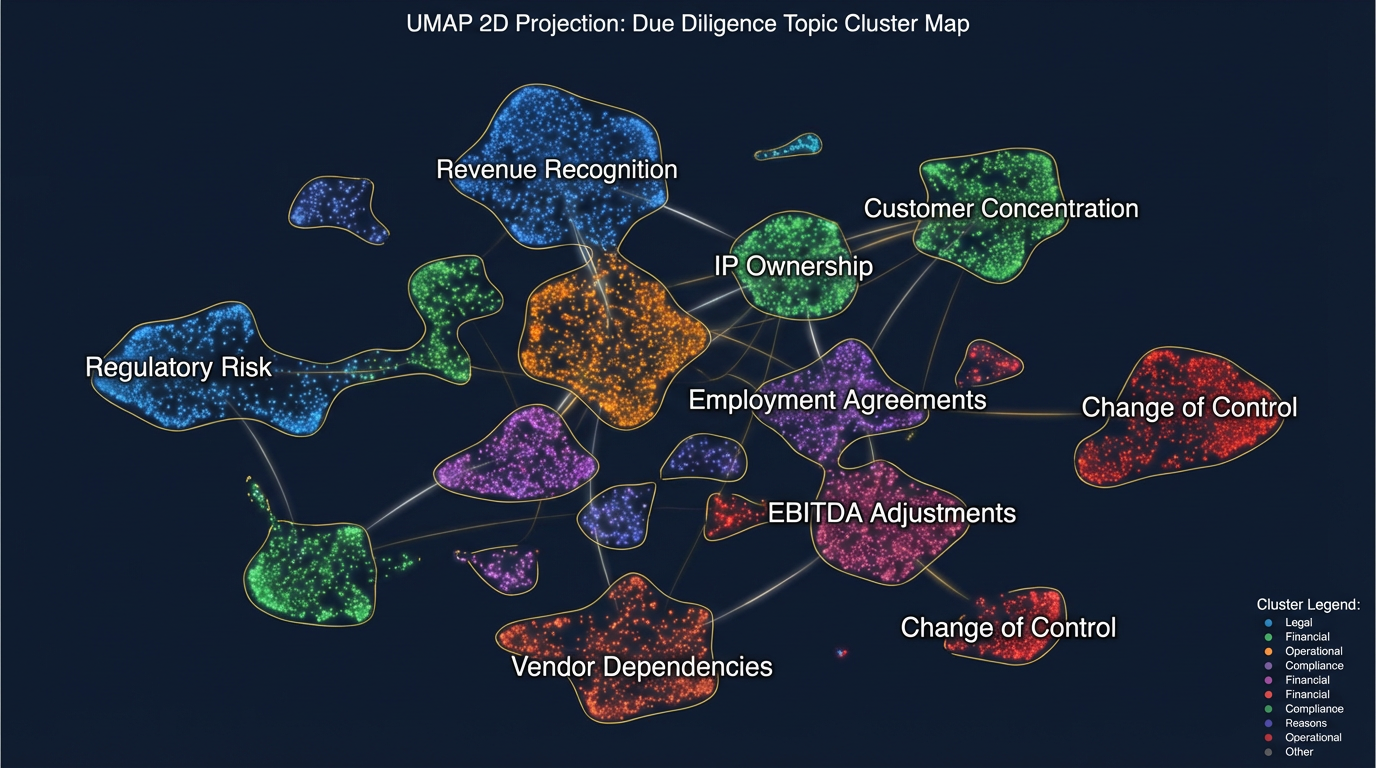
A proprietary engine that goes beyond the data room. CortexDD connects directly to a target's financial systems, CRM, email, HR platforms, and operational tools — pulling diligence-critical information at the source. The result: a smaller data room burden on the target, deeper coverage for the buyer, and structured diligence briefs backed by source evidence — produced in days, not months.
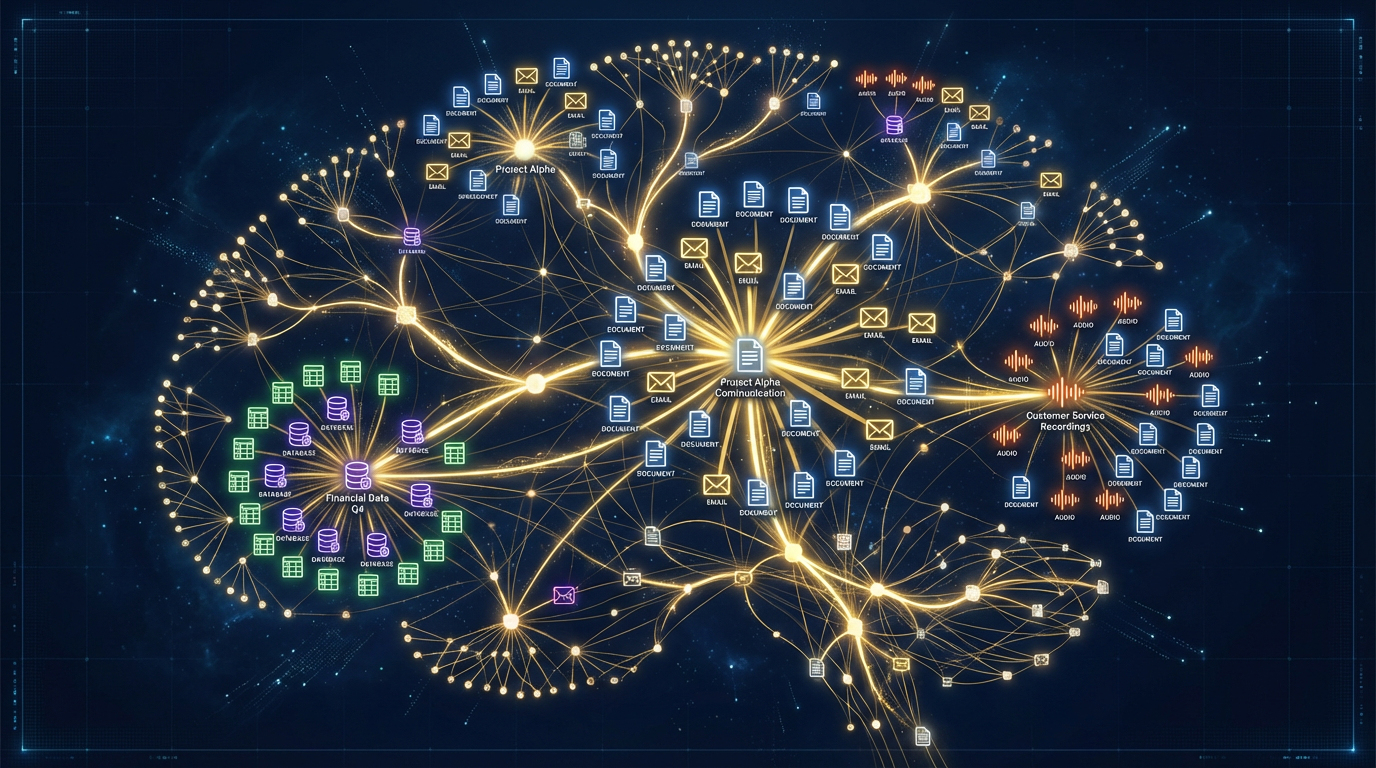
Cross-source relationship map — how CortexDD connects findings across the data room and live operating systems
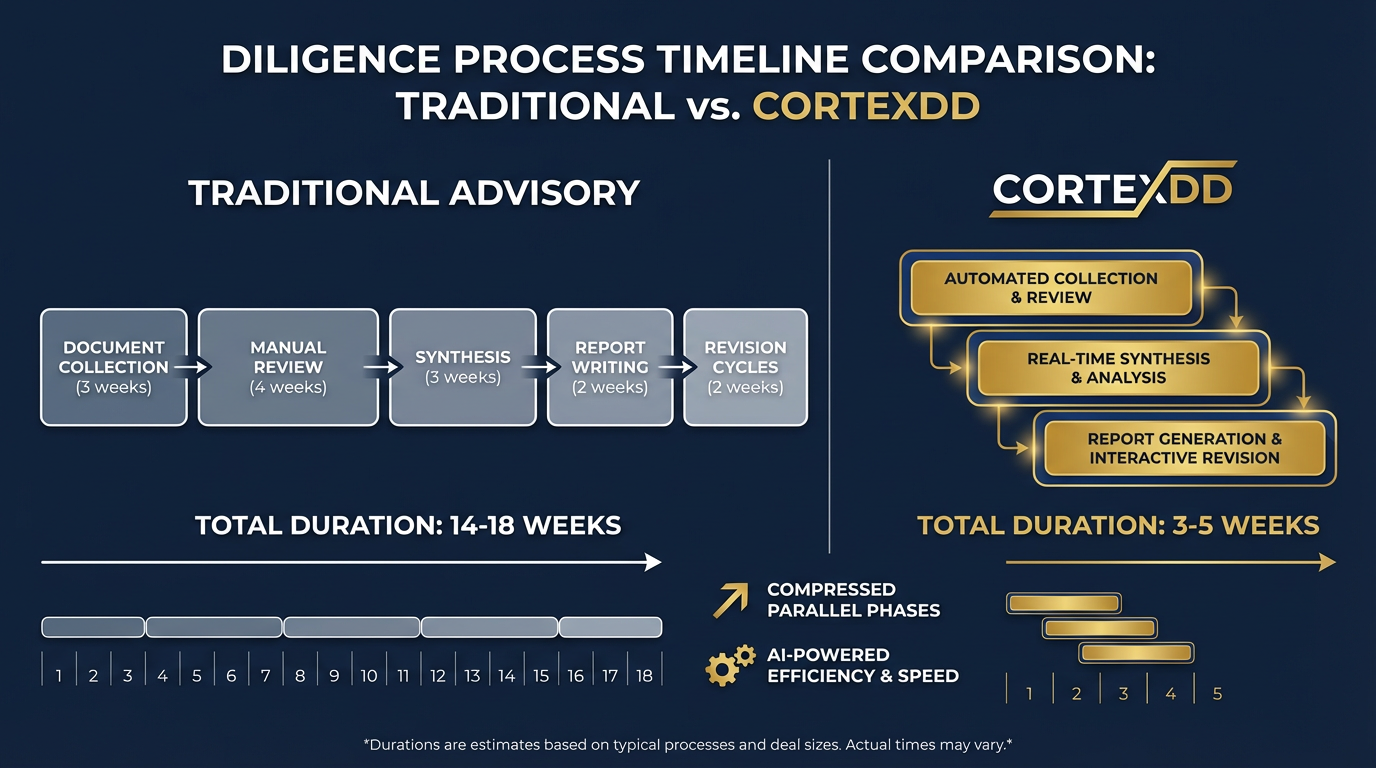
Traditional diligence is sequential — request documents, wait for the target to compile and upload them, assign reviewers, wait for synthesis, compile the report. Each phase is a bottleneck. Each data room request creates work for the target and delay for the buyer. CortexDD collapses this process from both sides.
Traditional sequential diligence vs. CortexDD — direct system access eliminates the request-and-wait cycle
Every advisory firm promises thoroughness. The difference is in what actually gets found, how fast it's found, and how much burden is placed on the target to produce it. CortexDD is not a generic tool applied to your deal — it is purpose-built and configured to the specific systems, structure, and risk profile of each transaction.
CortexDD reads every document in the data room and connects to the systems behind them — ERP, CRM, email, HR. It finds contradictions between management representations and what the systems actually show, surfaces concentrations invisible in any single document, and identifies gaps that would take a conventional team weeks to reconstruct.
Direct system access eliminates the request-and-wait cycle that defines traditional diligence. What takes four to eight weeks of analyst review is compressed to days — and the target's management team is freed from the operational burden of compiling and uploading thousands of documents.
CortexDD is configured for each engagement — the industry vocabulary, the specific risk factors, the deal-specific concerns your team needs answered. It doesn't force your transaction into a generic framework. It adapts to the unique structure and priorities of each deal.
Once the full scope — data room documents and live system data — has been analyzed, CortexDD produces structured diligence output. Standard templates cover every diligence dimension. Custom queries address the deal-specific concerns that matter most to your transaction.
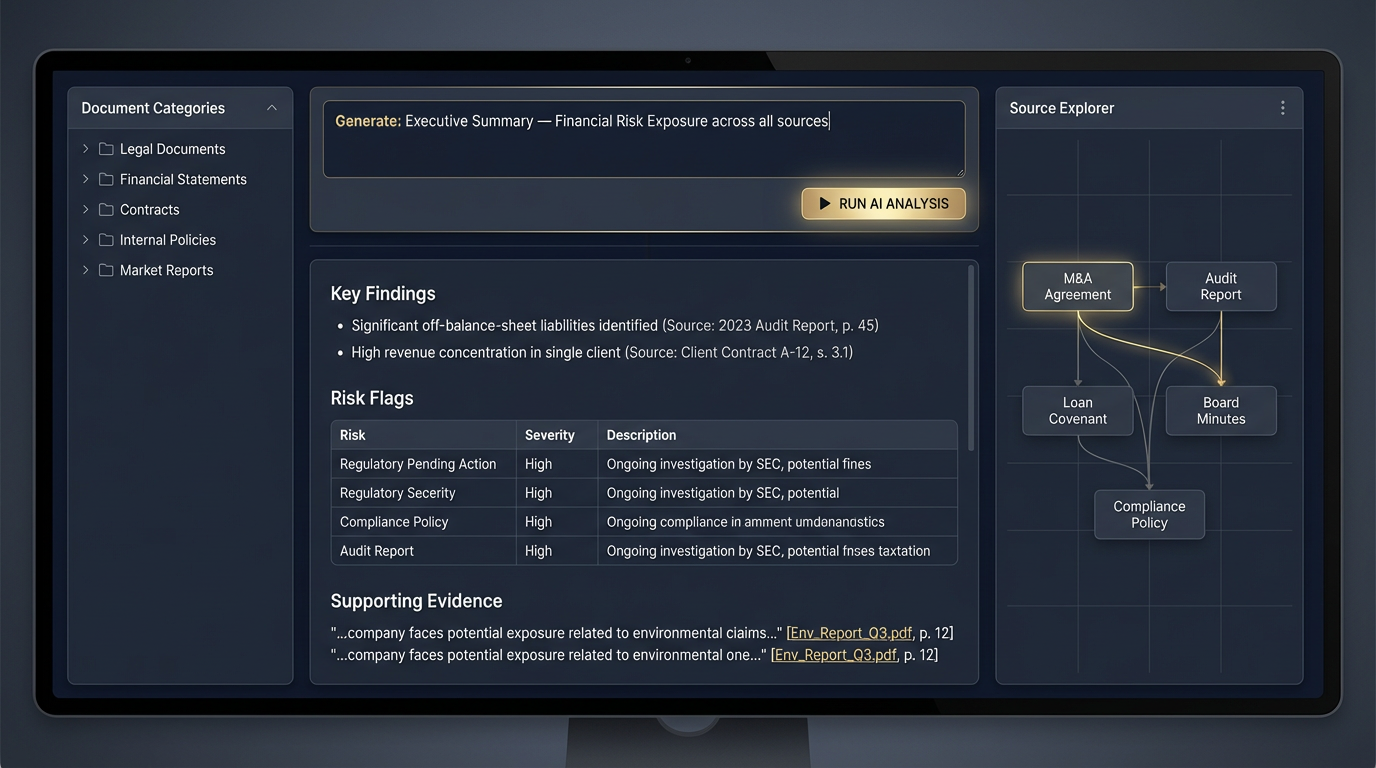
Every standard diligence dimension — Financial, Legal, Operational, Commercial, Technology, HR, Regulatory — is covered by structured output templates. Comprehensive coverage, produced in hours rather than weeks.
Every transaction has unique concerns — customer concentration, regulatory exposure, earn-out risk, integration complexity, key-person dependency. CortexDD answers deal-specific questions against the full scope of documents and system data, in plain language, with source citations.
No black-box conclusions. Every finding includes the specific document reference, system record, page, and supporting excerpt — whether it originated from the data room or a live operating system. Your team, your counsel, and your counterparty can independently verify every conclusion.
CortexDD doesn't wait for the target to populate a data room. It connects directly to the systems where the information lives — ERP, CRM, email, HR, PSA, contract management — and combines that live data with traditional data room materials. The result is deeper diligence coverage, a reduced burden on the target, and finished briefs produced in a fraction of conventional timelines.
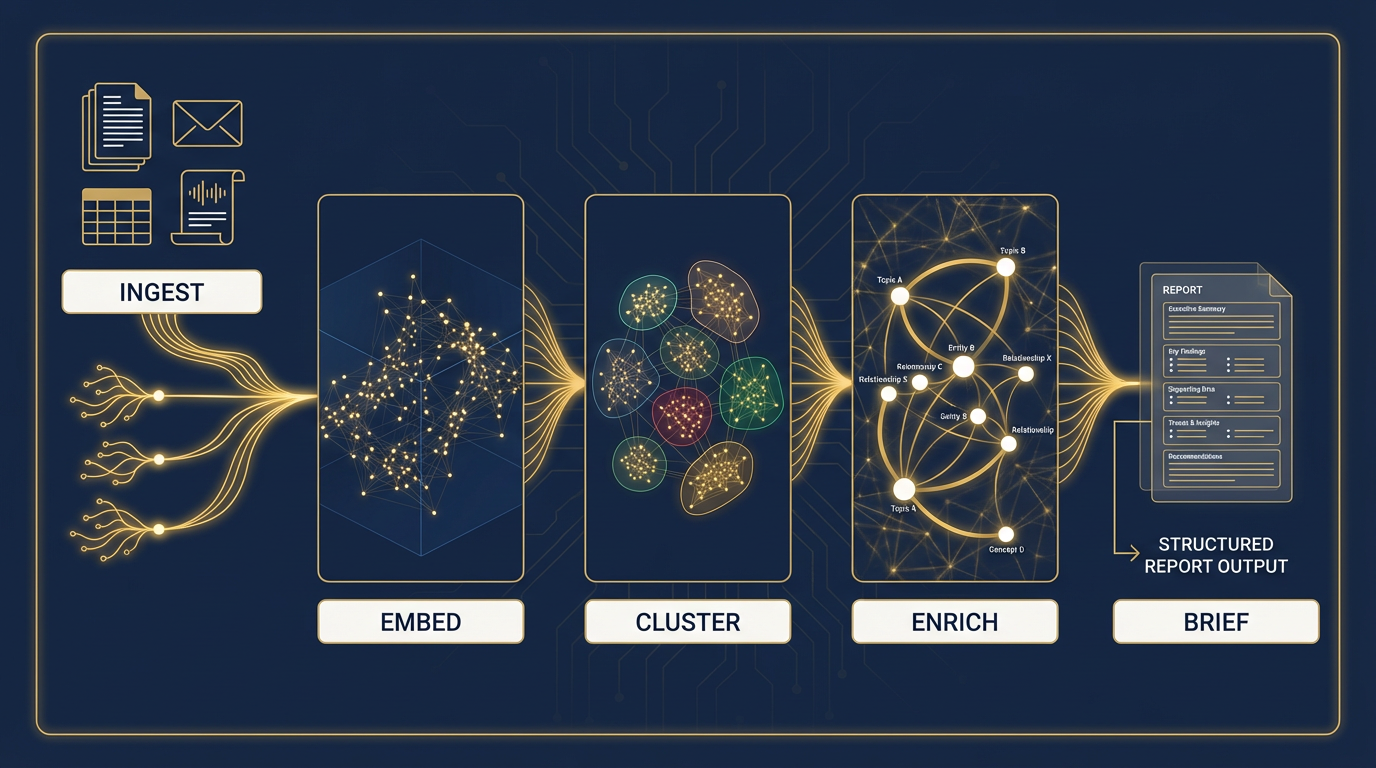
Data room documents are loaded alongside live feeds from the target's operating systems — ERP, CRM, email archives, HR platforms, PSA tools, contract repositories. Information is pulled from the source, not waiting for someone to export and upload it.
The system reads for meaning — not just keywords. A revenue figure pulled from the ERP, a related clause in a contract, and a contradictory statement in an email thread are all recognized as connected, even when the language and source systems differ entirely.
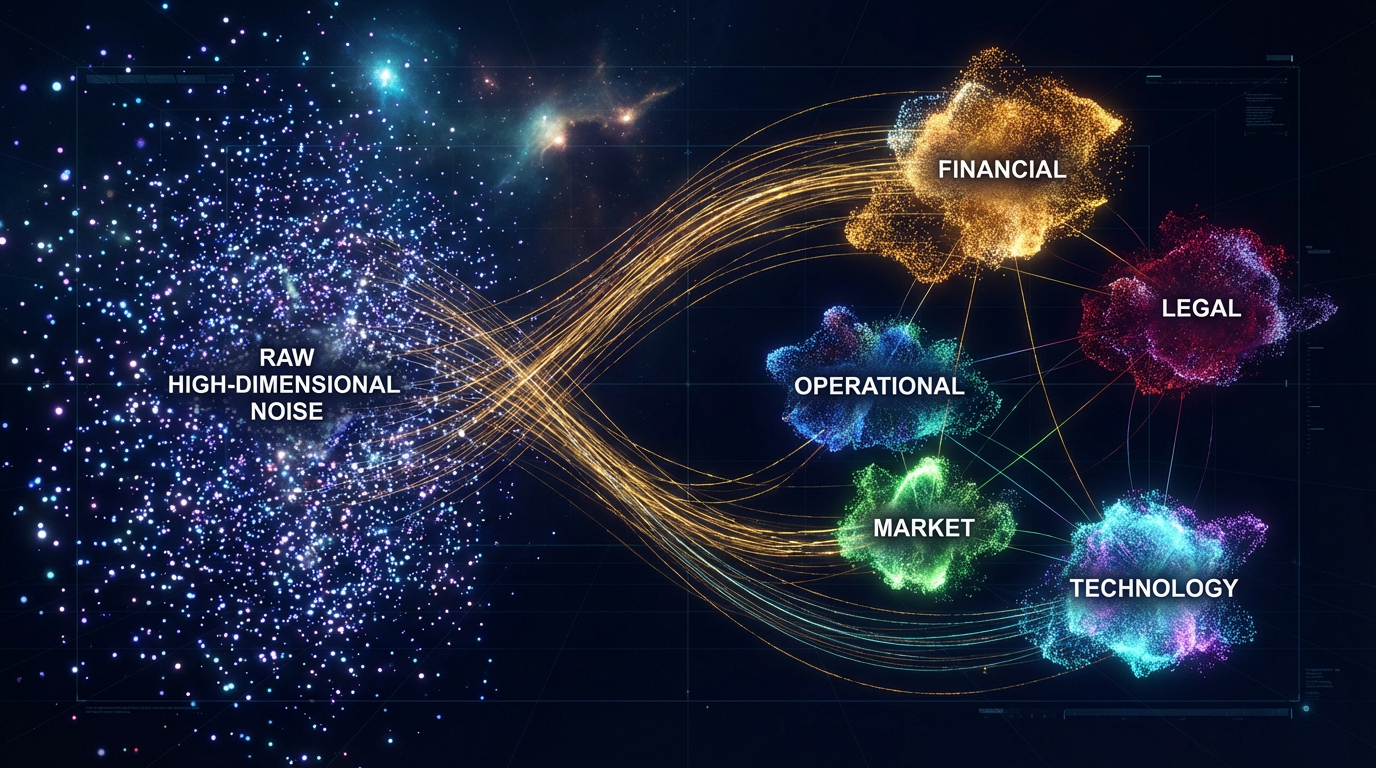
Hidden patterns, recurring risks, and undisclosed themes are surfaced automatically — not just from data room documents, but from the live system data that traditional diligence never sees. Patterns that span financials, email, HR records, and CRM data are identified in a single pass.
Every entity — company names, people, dates, financial figures, legal terms — is identified and cross-referenced across both documents and live system records. Claims in the CIM are verified against ERP data. Customer narratives are checked against CRM records. Nothing stays siloed.
Structured diligence output is produced across every relevant dimension — Financial, Legal, Operational, Commercial, Technology, HR, Regulatory — with every finding traced back to its source document.
Traditional diligence relies on sequential human reading — one document at a time, one analyst at a time — limited to whatever the target chose to put in the data room. CortexDD reads for meaning across a far wider scope: data room documents, ERP transaction histories, CRM pipeline data, email archives, HR records, and operational system exports — all analyzed as a single connected picture.
The result: a complete map of the target's operations organized by what it actually means. A CFO's email, a customer contract clause, a revenue figure in the ERP, and an employee record in the HR system that all relate to the same underlying issue are recognized as connected — regardless of where the information lives, what format it's in, or what terminology was used.
Cross-source intelligence map — data room documents and live system data organized by meaning and relevance
A data room contains what the target chose to share. CortexDD goes further — pulling from live systems to discover themes, concentrations, risks, and relationships that emerge from the full operational picture. Topics surface that no reviewer working from data room documents alone would ever reconstruct.
Diligence fails when information stays siloed. A representation in the CIM that contradicts ERP transaction data. A customer concentration visible only when CRM records, contracts, and financial statements are read together. A key-person dependency that surfaces only when email patterns and HR data are cross-referenced. These are the findings that change deal terms — and they require access to more than just a data room.
CortexDD identifies every company, individual, date, financial figure, and legal term across the full scope — data room documents and live system records — and links them. The result is a complete, searchable cross-reference where any claim made in any document can be traced to supporting evidence in the source systems — or to its contradiction.
Cross-source evidence map — data room documents, system records, email, and financials linked in one searchable view
CortexDD is deployed on every Holding Advisory engagement that requires diligence. It is not licensed or sold separately — it is the engine behind the thoroughness, speed, and precision of our work, and the reason our diligence goes deeper while placing less burden on the target.
Discuss an Engagement